Gender

Home/Gender

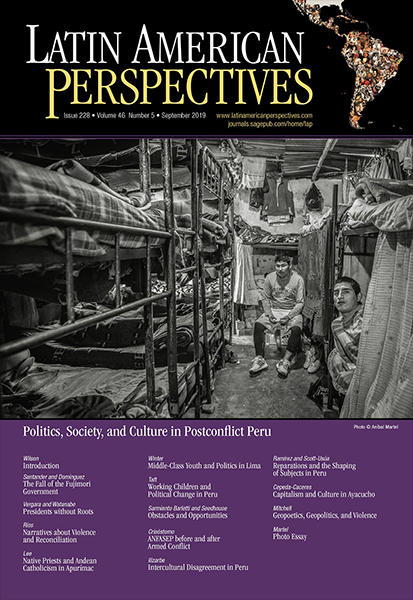
Politics, Society, and Culture in Postconflict Peru

Sept 2019 Issue editor: Kristi M. Wilson This issue of Latin American Perspectives focuses on the post-conflict period from Alberto Fujimori’s resignation in 2000 to the present, thus, challenging some of the popular notions of Peru as an exemplar of post-conflict reconstruction. The essays herein addresses important contributing factors to the Peruvian post-conflict landscape such as: questions of democracy and authoritarianism; extractivism, neo-extractivism and inequality among Peruvian indigenous communities; post-conflict development programs and initiatives; post-conflict reparations programs, the legacy of family planning programs in Peru; and the relationship between indigenous communities and the Peruvian state.   TABLE OF CONTENTS | PURCHASE THIS ISSUE
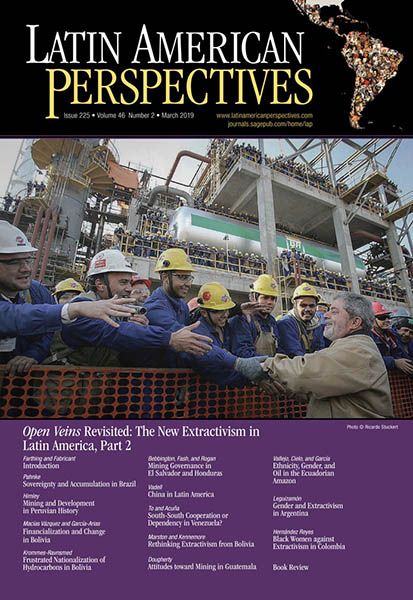
Issue #225 Mar 1 2019 Volume 46-2

  This issue continues the examination of the economic, social, and political impacts of expanded extractivism in Latin America and the perpetuation of the region’s role as a raw materials supplier for foreign markets that was started in the September 2018 issue (LAP 45 [5]).  With a broad geographic scope and consideration of a wide range of extractive industries from mining and hydrocarbons to soy, it combines critical theoretical insights with rich empirical research into the changing national and transnational structural relationships among governments, resource extracting and financial corporations, and the affected populations. Several articles critically assess the limitations of the extractivist policies of progressive governments. Others analyze the role of China and the actual experience of South-South cooperation.  Environmental justice issues and grass roots resistance are also considered  with attention to the roles of women, indigenous and Afro-descendent communities.     TABLE OF CONTENTS | PURCHASE THIS ISSUE
Issue #216 Sept. 1 2017 Volume 44-5

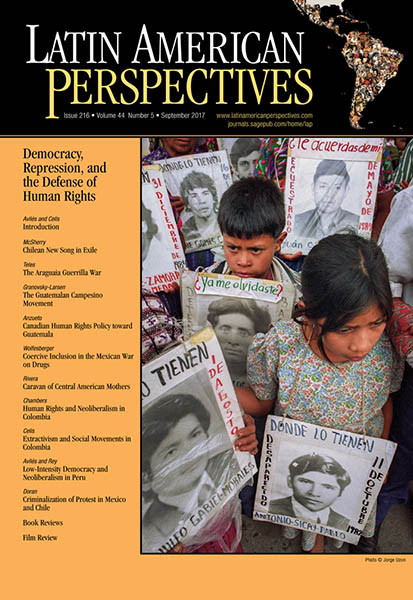
In the 1990s Barry Gills, Joel Rocamora, and Richard Wilson directly challenged the democratic-transitions literature by introducing the model of “low-intensity democracy” a largely procedural democracy that allows political opposition, greater individual freedoms, a reduced institutional role for the armed forces, and a more permeable environment for the investments of transnational capital. TABLE OF CONTENTS | PURCHASE THIS ISSUE
Issue #214 May 2017 Volume 44-3

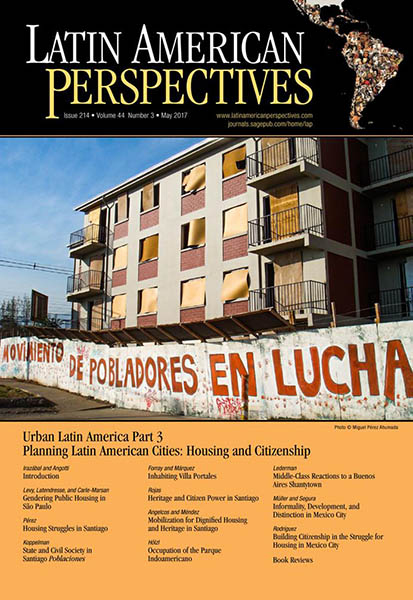
Urban social movements have contested the conditions under which people live and work in Latin America’s cities. The movements arose in response to the urban and housing policies of the neoliberal state, reflect deep contradictions of class, gender, poverty and informality, and signal the emergence of new forms of citizenship. TABLE OF CONTENTS | PURCHASE THIS ISSUE