Culture

Home/Culture

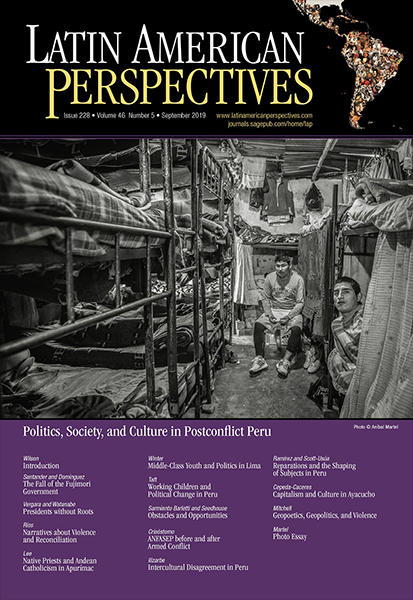
Politics, Society, and Culture in Postconflict Peru

Sept 2019 Issue editor: Kristi M. Wilson This issue of Latin American Perspectives focuses on the post-conflict period from Alberto Fujimori’s resignation in 2000 to the present, thus, challenging some of the popular notions of Peru as an exemplar of post-conflict reconstruction. The essays herein addresses important contributing factors to the Peruvian post-conflict landscape such as: questions of democracy and authoritarianism; extractivism, neo-extractivism and inequality among Peruvian indigenous communities; post-conflict development programs and initiatives; post-conflict reparations programs, the legacy of family planning programs in Peru; and the relationship between indigenous communities and the Peruvian state.   TABLE OF CONTENTS | PURCHASE THIS ISSUE
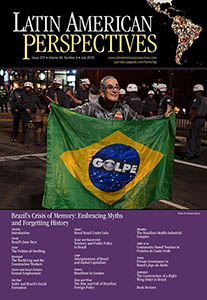
Issue #227 July 1 2019 Volume 46-4

  This issue is devoted to Brazil and examines how the last few years have brought significant transformations to the government and society, which defy earlier expectations, both positive and negative.  Articles focus on political and economic subjects ranging from public demonstrations and labor unionization, the results of the PT administrations’ policies of land reform and healthcare management, to the difficulties brought on by the international recession, as well as questions of historical formation, cultural construction, self-identity, self-definition and criticism, and the conservative backlashes which have led to the rise of the rightist regime now in power.   TABLE OF CONTENTS | PURCHASE THIS ISSUE
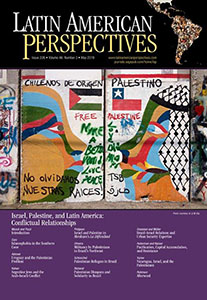
Issue #225 May 1 2019 Volume 46-3

  This issue of LAP represents a step toward a better understanding of the Israeli-Palestinian conflict in a Latin American context. The articles cover a range of historical and current topics and show that Arab and Jewish histories are an integral part of Latin American history, that Latin America has been an important actor in the conflict over Palestine, and that the issue is being played out today in ever-changing circumstances.  Historical topics address how specific Latin American countries dealt with the creation of Israel and the Six-Day War while other articles consider more recent topics including the role and treatment of the Palestinian diaspora and Israeli marketing of urban security expertise.     TABLE OF CONTENTS | PURCHASE THIS ISSUE
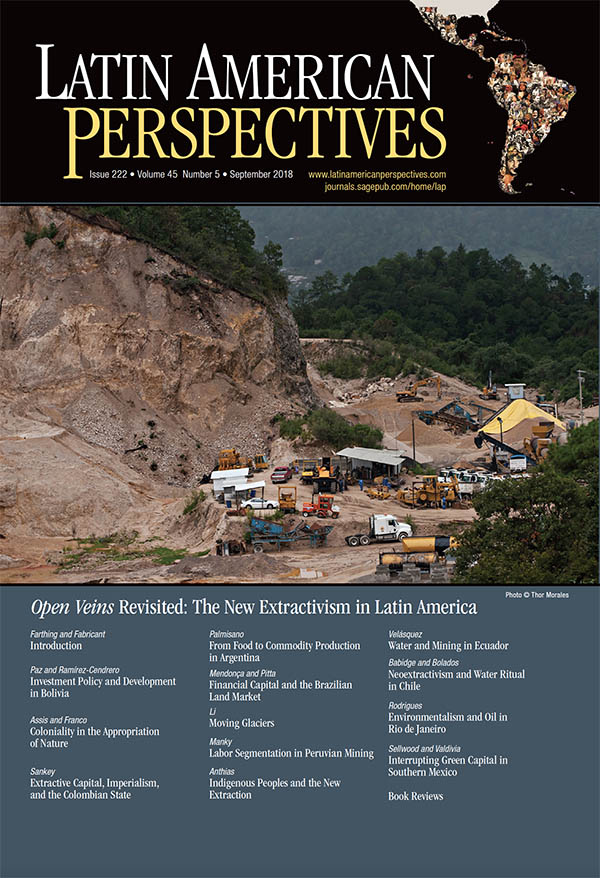
Issue #222 Sept 1 2018 Volume 45-5

Ever since the elusive search for El Dorado began in the 16th century, the history of Latin America has been a tale of resource extraction. This issue focuses on the interconnections and impacts of global resource-based economies on topics as wide-ranging as local people and their environments, national policies and international financial capital. Rather than finding neat and tidy conclusions, it suggests that nuanced social, political economic analyses better enable us to understand and analyze how contemporary extractivism is reshaping Latin America.   TABLE OF CONTENTS | PURCHASE THIS ISSUE
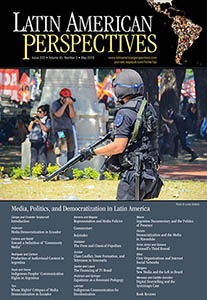
Issue #220 May 1 2018 Volume 45-3

More than a half century after the publication of Rodolfo Stavenhagen’s landmark essay “7 Erroneous Thesis about Latin America”, its critique of dominant development thinking remains sharp, as was shown at a colloquium hosted by El Colegio de México 50 years to the day after the publication of  the original text. TABLE OF CONTENTS | PURCHASE THIS ISSUE
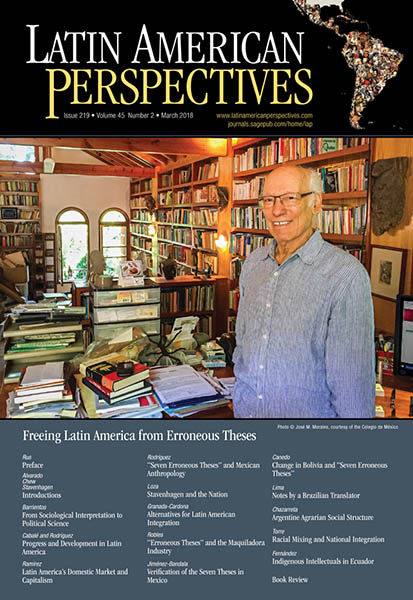
Issue #219 Mar. 1 2018 Volume 45-2

More than a half century after the publication of Rodolfo Stavenhagen’s landmark essay “7 Erroneous Thesis about Latin America”, its critique of dominant development thinking remains sharp, as was shown at a colloquium hosted by El Colegio de México 50 years to the day after the publication of  the original text. TABLE OF CONTENTS | PURCHASE THIS ISSUE
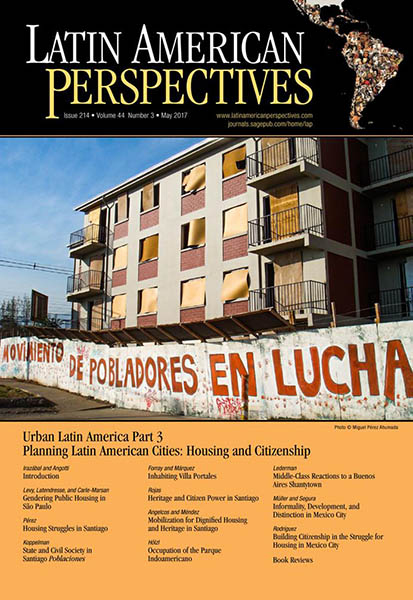
Issue #214 May 2017 Volume 44-3

Urban social movements have contested the conditions under which people live and work in Latin America’s cities. The movements arose in response to the urban and housing policies of the neoliberal state, reflect deep contradictions of class, gender, poverty and informality, and signal the emergence of new forms of citizenship. TABLE OF CONTENTS | PURCHASE THIS ISSUE