charles@cmmstudio.com

Home/charles@cmmstudio.com

About charles@cmmstudio.com

This author has not yet filled in any details.
So far charles@cmmstudio.com has created 129 blog entries.

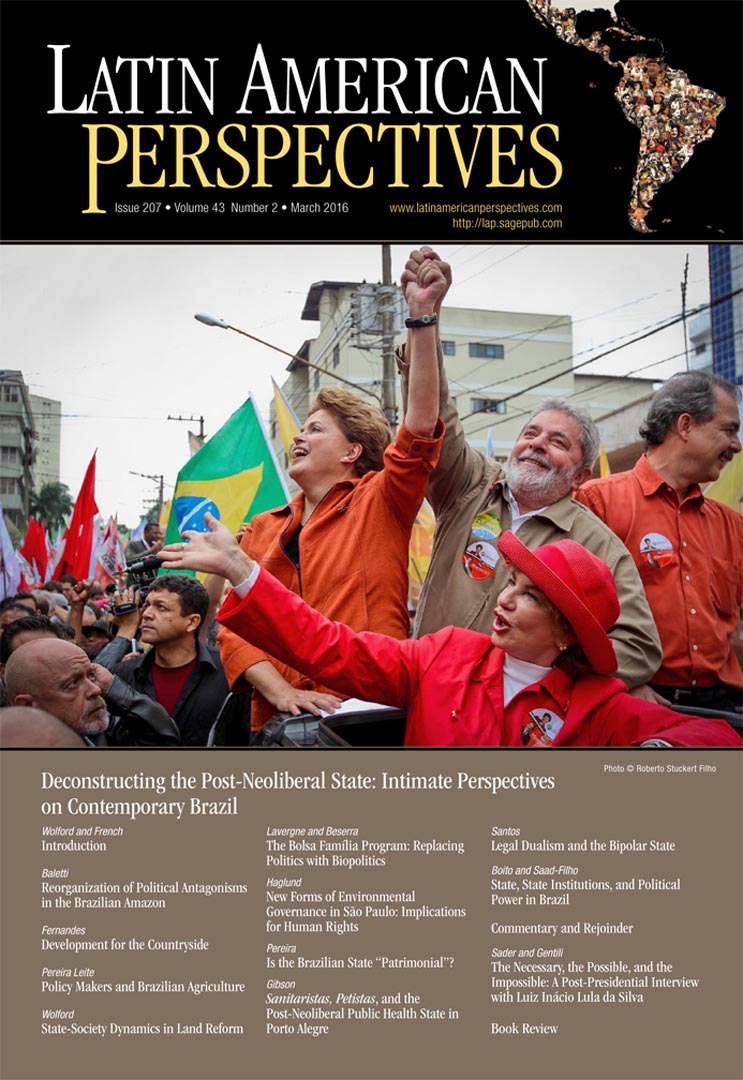
Deconstructing the Post-Neoliberal State: Intimate Perspectives on Contemporary Brazil

Deconstructing the Post-Neoliberal State: Intimate Perspectives on Contemporary Brazil Issue #: 207 | Volume #: 43 | Number #: 2 Date: March 2016 Interviewer: Tomas Ocampo Interviewees: Wendy Wolford and John French Short Description: This issue brings together critical contributions to help appreciate some dimensions of the profound impact of the deep socio-economic and political transformations that the Citizen Revolution led by Rafael Correa has been pushing for since its inception in 2007. The main purpose of the issue is to arrive at a global picture of the evolution and the vicissitudes of the processes of political change in contemporary Ecuador, assess its limits and contradictions from the standpoint of various analytical approaches. It covers such diverse topics as the struggle for power, the reform of state institutions towards a more centralized model, economic and trade policy, change in Ecuador’s approach to international relations, the question of constitutional change, tensions between the government and social movements, socio-environmental conflicts, the new migration agenda, and the question of the post-neoliberalism. LATIN AMERICAN PERSPECTIVES is a theoretical and scholarly journal for discussion and debate on the political economy of capitalism, imperialism, and socialism in the Americas. For more than forty years, it has [...]
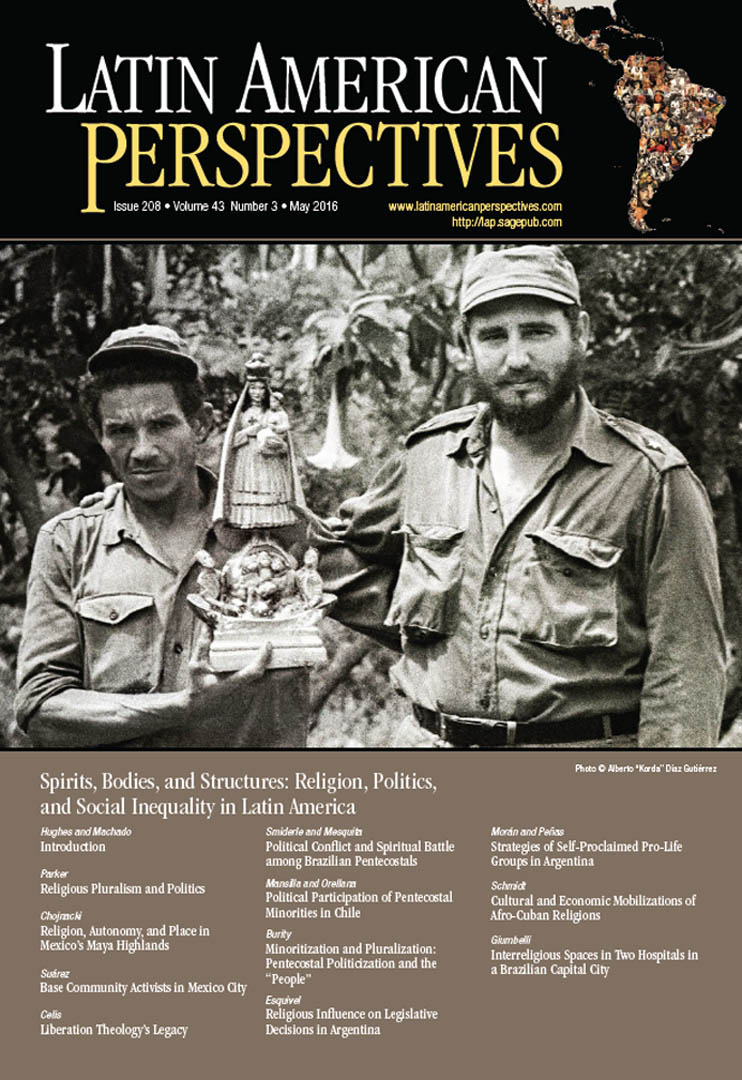
Spirits, Bodies, and Structures: Religion, Politics, and Social Inequality in Latin America

Spirits, Bodies, and Structures: Religion, Politics, and Social Inequality in Latin America Issue #: 208  | Volume #: 43  | Number #: 3 Date: May 2016 Interviewer: Tomas Ocampo Interviewees: Jennifer Scheper Hughes Short Description: This special issue of Latin American Perspectives returns to consider the theme of religion and social inequality and the social movements that seek to address religions’ ambivalent legacy across the continent. The articles take up a materialist approach to the subject of religion—they are concerned with the poor and disenfranchised, and not just with their beliefs and religious practices but also with their bodies and earthly fates. Liberation theology continues to shape the political landscape of Latin America, and numerous religious transformations are taking place which may be understood as the afterlives of liberation theology. Evangelical Christian movements, now no longer identified with particular ideologies, insert themselves into the public sphere. The state is now compelled to account for religions other than Christianity and to respond to the rapid pluralization of religious identities and constituencies across the continent. LATIN AMERICAN PERSPECTIVES is a theoretical and scholarly journal for discussion and debate on the political economy of capitalism, imperialism, and socialism in the Americas. For more than [...]

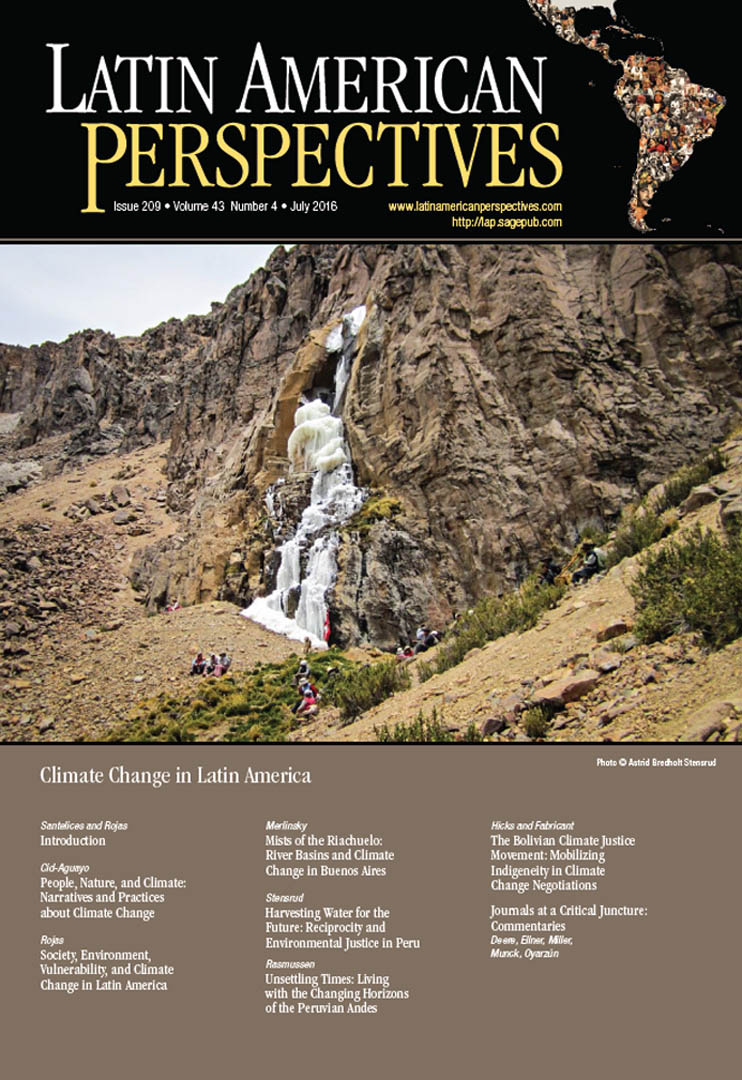
Climate Change in Latin America

Climate Change in Latin America Issue #: 209  | Volume #: 43  | Number #: 4 Date: July 2016 Interviewer: Tomas Ocampo Interviewees: Jorge Rojas Hernandez Short Description: This issue provides a counterpoint to the global and diplomatic drama of the Paris climate negotiations by offering a territorialized, bottom-up approach that breaks with the asymmetrical “North-South” logic of (developed) winners and (less developed) losers. The articles describe local governance strategies, based on effective responses rather than victimhood, that suggest a paradigm shift in how to conceptualize citizen particiation, especially in relation to water use and rights. LATIN AMERICAN PERSPECTIVES is a theoretical and scholarly journal for discussion and debate on the political economy of capitalism, imperialism, and socialism in the Americas. For more than forty years, it has published timely, progressive analyses of the social forces shaping contemporary Latin America. http://latinamericanperspectives.com

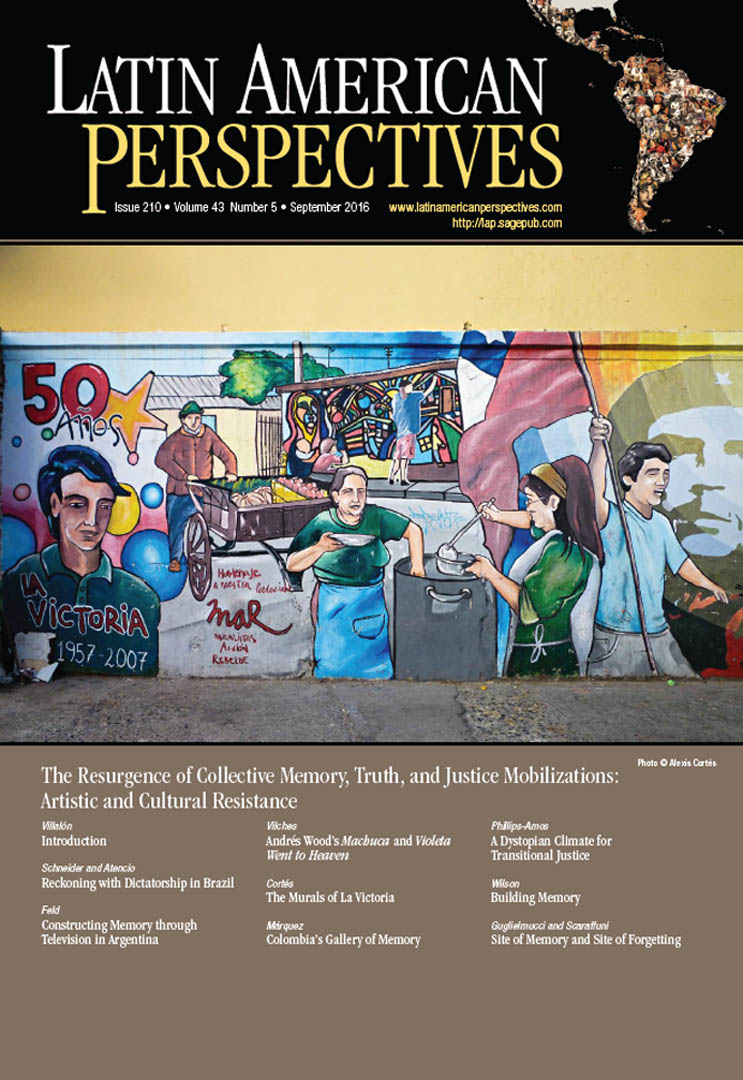
The Resurgence of Collective Memory, Truth, and Justice Mobilizations Part 3: Culture, Politics, and Social Mobilizations

The Resurgence Of Collective Memory, Truth, And Justice Mobilizations Part 2: Art, Culture, And Violence Issue #: 210 | Volume #: 43 | Number #: 5 Date: September 2016 Interviewer: Tomas Ocampo Interviewees: Roberta Villalon Short Description: Since the turn of the century, various Latin American countries have witnessed a second wave of memory, truth, and justice mobilizations to address unresolved human rights abuses of past military regimes and civil conflicts. This issue—the second of a three-part series on the politics of collective memory—illustrate how artistic and cultural expressions have been created and used to tackle these dilemmas and informed memorialization, justice seeking, and reconciliation in Brazil, Argentina, Chile, Colombia, and Uruguay. These studies point to how the limitations of democratization, peace, and reconciliation processes have shaken communities into collective mobilization including the use of artistic and cultural means to keep memory alive and push for justice. LATIN AMERICAN PERSPECTIVES is a theoretical and scholarly journal for discussion and debate on the political economy of capitalism, imperialism, and socialism in the Americas. For more than forty years, it has published timely, progressive analyses of the social forces shaping contemporary Latin America. http://latinamericanperspectives.com  

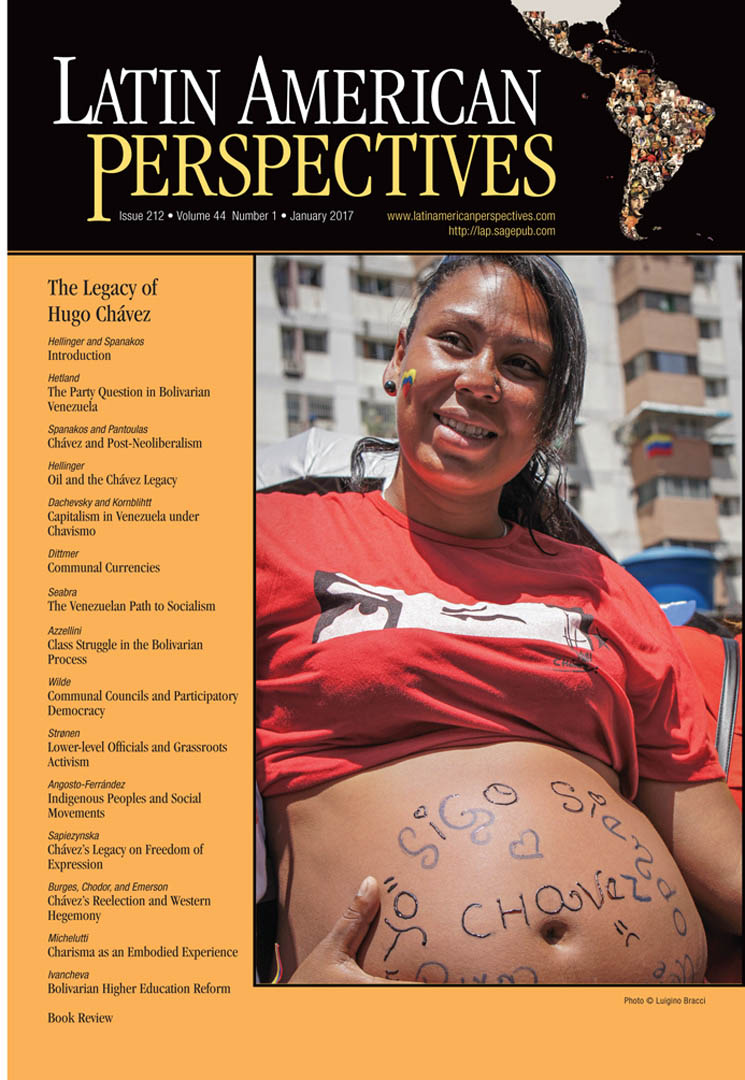
The Legacy of Hugo Chávez

The Legacy of Hugo Chávez Issue #: 212  |  Volume #: 44  |  Number #: 1 Date: January 2017 Interviewer: Tomas Ocampo Interviewees: Daniel Hellinger and Anthony Petros Spanakos Short Description: The purpose of this special issue is contribute to a better understanding of the possibilities and limits of the Bolivarian project, ranging from democratic innovations to economic experimentation, from alternative economic integration to the role of charisma in revolutionary politics. Contributions include analysis of what it means to be a citizen in a post-neoliberal democracy in Venezuela; the extent to which Chavismo achieved a real redistribution of socio-economic and political power in Venezuela; lessons for other countries dependent upon extraction; what sort of domestic political and economic institutional structures have been developed under Chávez’s government, and how these affect the question of succession and future governability; the sustainability of the Bolivarian project since the decline in oil prices; and the relationship of Venezuela with the United States and other Latin American countries. LATIN AMERICAN PERSPECTIVES is a theoretical and scholarly journal for discussion and debate on the political economy of capitalism, imperialism, and socialism in the Americas. For more than forty years, it has published timely, progressive analyses of [...]

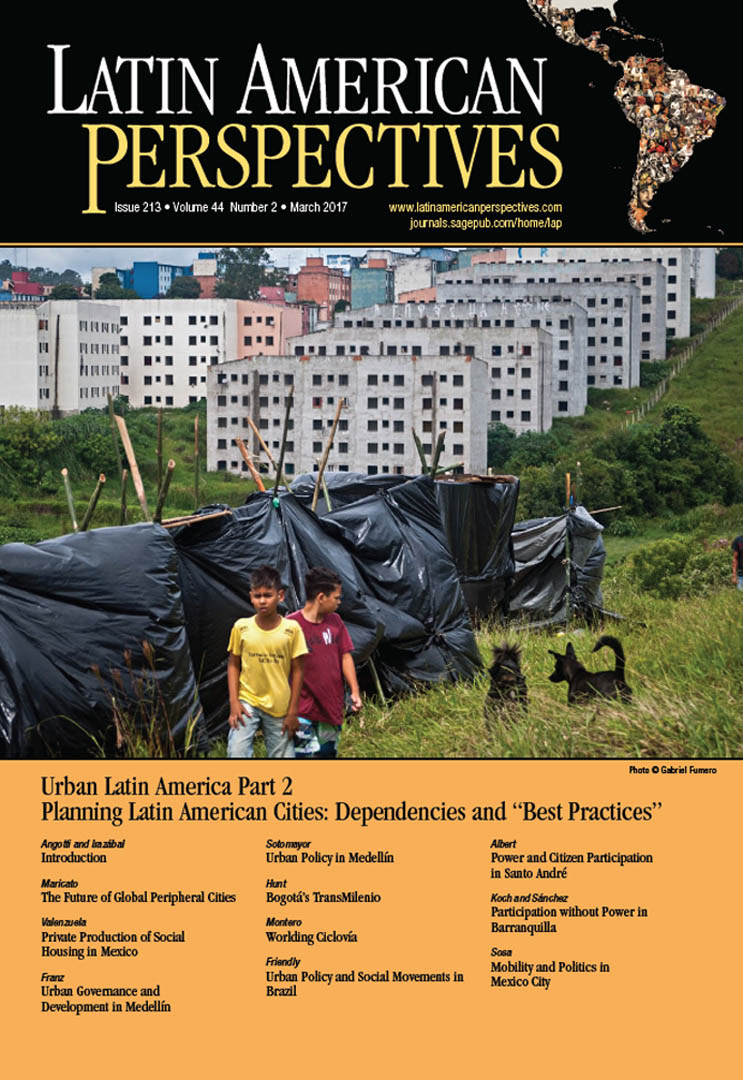
Urban Latin America: Part 2: Planning Latin American Cities: Dependencies and “Best Practices”

Urban Latin America: Part 2: Planning Latin American Cities: Dependencies and “Best Practices” Issue #: 213  | Volume #: 44  | Number #: 2 Date: March 2017 Interviewer: Tomas Ocampo Interviewees: Tom Angotti and Clara Irazábal Short Description: Urban planning in Latin America reflects the historic dependencies and inequalities of peripheral capitalism. These were amplified by recent neoliberal reforms in housing, transportation and social policy. This issue looks critically at urban reforms in these areas, the role of social movements and the emergence of “best practices” including social urbanism, bus rapid transit, bicycle infrastructure, and participatory budgeting, with more to come in the next LAP issue. LATIN AMERICAN PERSPECTIVES is a theoretical and scholarly journal for discussion and debate on the political economy of capitalism, imperialism, and socialism in the Americas. For more than forty years, it has published timely, progressive analyses of the social forces shaping contemporary Latin America. http://latinamericanperspectives.com

Urban Latin America: Part 3: Planning Latin American Cities: Housing and Citizenship

Urban Latin America: Part 3: Planning Latin American Cities: Housing and Citizenship Issue #: 214  | Volume #: 44  | Number #: 3 Date: May 2017 Interviewer: Tomas Ocampo Interviewees: Tom Angotti and Clara Irazábal Short Description: Urban social movements have contested the conditions under which people live and work in Latin America’s cities. The movements arose in response to the urban and housing policies of the neoliberal state, reflect deep contradictions of class, gender, poverty and informality, and signal the emergence of new forms of citizenship. LATIN AMERICAN PERSPECTIVES is a theoretical and scholarly journal for discussion and debate on the political economy of capitalism, imperialism, and socialism in the Americas. For more than forty years, it has published timely, progressive analyses of the social forces shaping contemporary Latin America. http://latinamericanperspectives.com

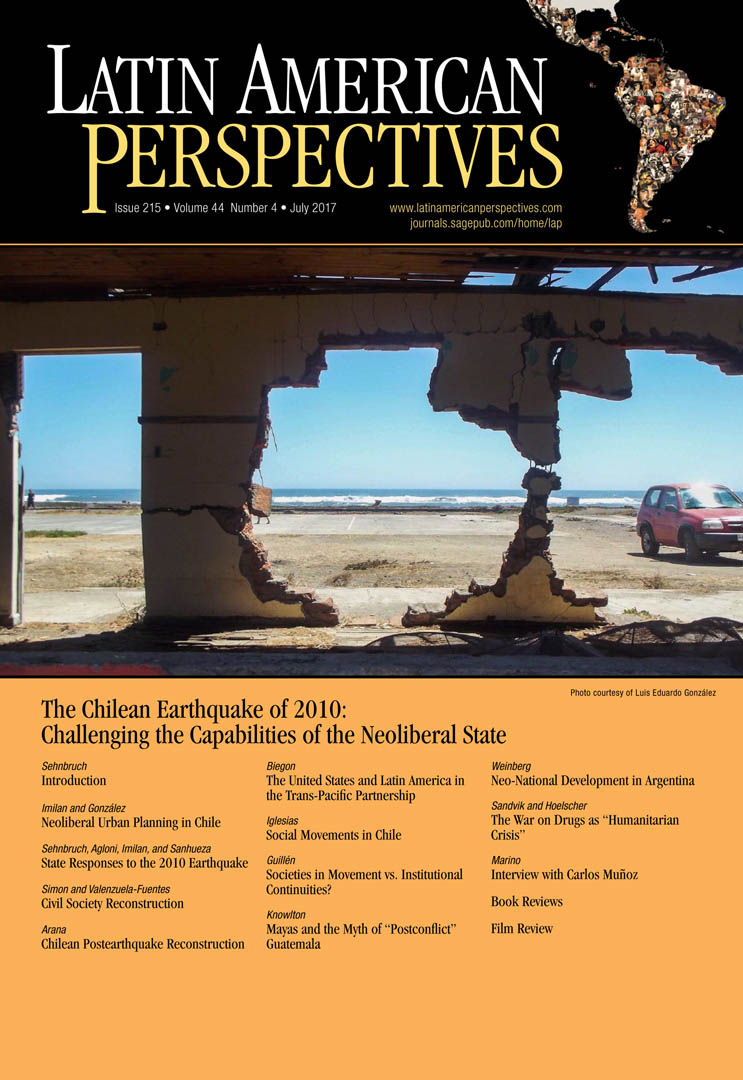
The Chilean Earthquake of 2010: Challenging the Capabilities of the Neoliberal

The Chilean Earthquake of 2010: Challenging the Capabilities of the Neoliberal State Issue #: 215  | Volume #: 44 | Number #: 4 Date: July 2017 Interviewer: Tomas Ocampo Interviewees: Kristen Sehnbruch Short Description: On February 27th 2010, southern Chile was hit by an 8.8 magnitude earthquake followed by several devastating tsunamis. The disaster cost 575 lives and economic losses equivalent to 18% of Chile’s GDP. Although Chile’s earthquake resistant construction prevented far greater damage and its institutions proved to be relatively well equipped for disaster relief, all the weaknesses of an atrophied neoliberal state became evident during a reconstruction process based on decentralized public-private partnerships formed to implement over 100 local  “master plans.” This special issues analyses the responses from politicians, policy makers, corporations, and civil society and situates them in their institutional and constitutional context. LATIN AMERICAN PERSPECTIVES is a theoretical and scholarly journal for discussion and debate on the political economy of capitalism, imperialism, and socialism in the Americas. For more than forty years, it has published timely, progressive analyses of the social forces shaping contemporary Latin America. http://latinamericanperspectives.com

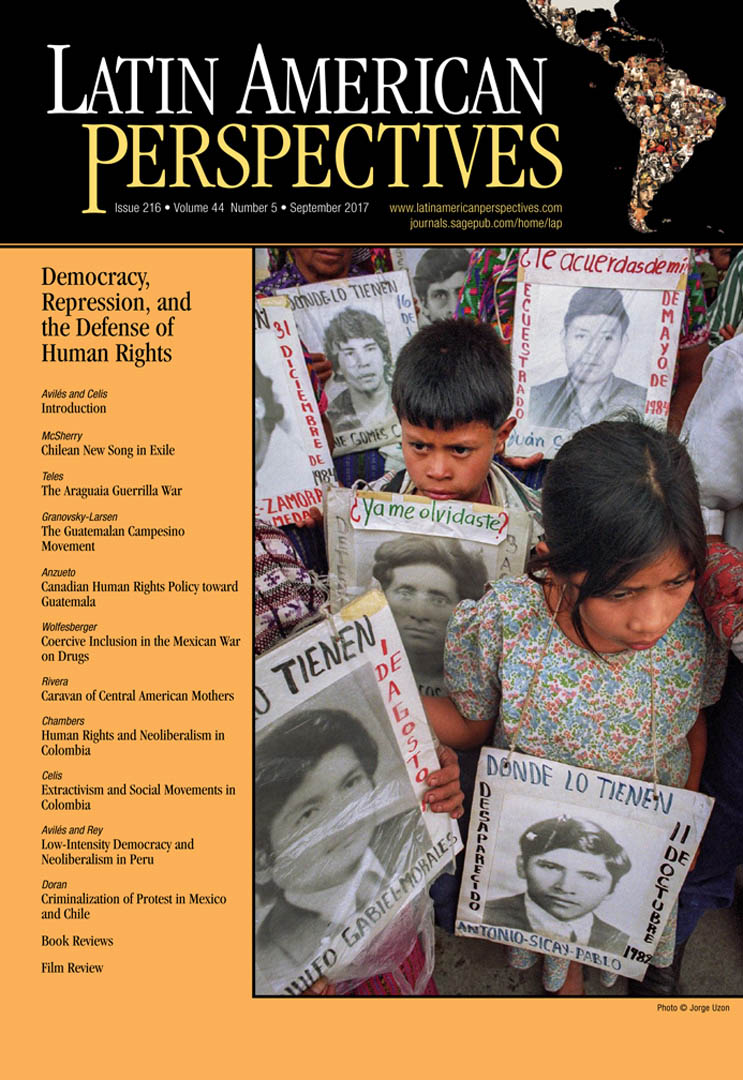
Democracy, Repression, and the Defense of Human Rights

Title: Democracy, Repression, and the Defense of Human Rights Issue #: 216  | Volume #: 44  | Number #: 5 Date: September 2017 Interviewer: Tomas Ocampo Interviewees: William Avilés and Leila Celis Short Description: In the 1990s Barry Gills, Joel Rocamora, and Richard Wilson directly challenged the democratic-transitions literature by introducing the model of “low-intensity democracy” a largely procedural democracy that allows political opposition, greater individual freedoms, a reduced institutional role for the armed forces, and a more permeable environment for the investments of transnational capital. LATIN AMERICAN PERSPECTIVES is a theoretical and scholarly journal for discussion and debate on the political economy of capitalism, imperialism, and socialism in the Americas. For more than forty years, it has published timely, progressive analyses of the social forces shaping contemporary Latin America. http://latinamericanperspectives.com

Modern Slavery and Human Trafficking in Latin America

Modern Slavery and Human Trafficking in Latin America Issue #: 217  | Volume #: 44 |  Number #: 6 Date: November 2017 Interviewer: Alexander Scott Interviewees: Daniela Issa Short Description: Modern slavery and human trafficking affect an estimated 1.8 million people in Latin America and the Caribbean today yet remain significantly understudied given their devastating human consequences. This issue addresses this gap in the slavery and trafficking scholarship by taking a critical look at it across the region and situating it within the transnational capitalist economy. Articles include theoretical analyses of the phenomenon as well as recruitment practices, populations susceptible to being enslaved/trafficking, and the role of violence. Additionally, it seeks to provide regional balance in the literature on slavery and trafficking in Latin America, which has disproportionately centered on Brazil; it highlights three underresearched areas—slavery outside Brazil, nonsexual slavery, and smugglers/traffickers rather than victims exclusively. LATIN AMERICAN PERSPECTIVES is a theoretical and scholarly journal for discussion and debate on the political economy of capitalism, imperialism, and socialism in the Americas. For more than forty years, it has published timely, progressive analyses of the social forces shaping contemporary Latin America. http://latinamericanperspectives.com