charles@cmmstudio.com

Home/charles@cmmstudio.com

About charles@cmmstudio.com

This author has not yet filled in any details.
So far charles@cmmstudio.com has created 129 blog entries.

Brazil and the Fight Against Many Pandemics

By David Miranda,  Fernanda Melchionna, and Sâmia Bomfim Federal Representatives of the Socialism and Freedom Party (PSOL) in Brazil | April 23, 2020 While the national health system collapses and the new coronavirus reaches hundreds of thousands of people, Brazil is facing a struggle against more than one pandemic. The most recent and dramatic one is that of COVID-19. But the impact of the virus is exacerbated by epidemics of political authoritarianism, social inequality and violence, including gender violence, that punish the country, as an example of what occurs around the world. Under the command of what is perhaps the worst president in the world, the largest country in Latin America is experiencing a dramatic crisis that puts millions of citizens at risk. It is necessary to take into account the context in which Brazil was affected by the coronavirus. For at least five years, the country has suffered from unbridled economic plunder driven by the ultra-neoliberal adjustment agenda. Although gigantic democratic demonstrations took place in 2013, demanding more rights, the country's demoralized political class acted in a direction contrary to popular aspirations. This approach started under Dilma Rousseff (PT) and reached unimaginable levels under the coup government [...]
The Trump of the Tropics Virus

By Cliff Welch, São Paulo, Brazil | April 20, 2020 With the Covid-19 pandemic, most days’ news reminds me of Marx’s phrase about history repeating itself, first as tragedy, second as farce. As I regularly consume news about the United States, the tragedy plays out daily in the magnitude of the disease’s spread, the runaway death count and the ineffective, egocentric responses of President Donald Trump. In contrast, news about governors like New York’s Andrew Cuomo and California’s Gavin Newsom, stimulate hope. But, here in Brazil, hope is presented as a horizon sublimely blind to facts learned the hard way in globe’s far flung corners. President Jair Bolsonaro tells people to go back to work. He characterizes Covid-19 as a “little flu” and spectacularly defies prohibitions on social isolation and distancing. On April 19, he addressed a rally in front of the Brazilian Army headquarters in Brazil’s capital city. Defying social distancing guidelines, Bolsonaro’s supporters called on the Army to intervene by shutting down the congress and supreme court. “We don’t want to negotiate anything,” Bolsonaro told the crowd. “Count on your president…to guarantee…our freedom.” Two days earlier, he fired his health minister for advocating policies established by [...]

Abstract – Labor Market and Labor Relations under the PT Governments

Labor Market and Labor Relations under the PT Governments by Ana Paula Fregnani Colombi, José Dari Krein | April 22, 2020 There is some consensus on the foreign policy of Dilma Rousseff’s government that Brazil lost prestige and international influence because of her lesser personal dedication. Against this consensus, the paper presents two alternative hypotheses for explaining its unsatisfactory outcomes: that there was no change in policy objectives but an adaptation to a more hostile context and that its limitations were structurally related to dependency on global corporations and to the increasing rejection of South-South politics by domestic business. If this analysis is correct, the structural limitations described require that the struggle to achieve an independent foreign policy involve deeper political and ideological battles and a more radical questioning of neoliberal capitalism. Abstract In its 12 years in government, Brazil’s Partido dos Trabalhadores (Workers’ Party—PT) promoted inclusion through the labor market and through consumption with an increase in labor flexibility. Despite an increase in employment and incomes, the increase in the heterogeneity of the labor market and in flexibilization has resulted in a deepening of the insecurity and vulnerability of workers in line with the new trends that contemporary [...]

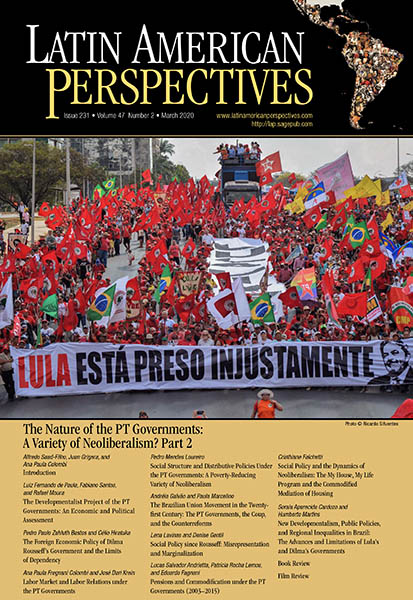
The Nature of the PT Governments: A Variety of Neoliberalism? Part 2

fusion_text] March 2020 Issue Editors: Alfredo Saad-Filho, Juan Grigera, and Ana Paula Colombi Part II of this issue discusses the nature, strengths, achievements, contradictions, and limitations of the administrations led by the PT in federal government, questioning whether they can be characterized as a variety of neoliberalism. Besides macroeconomic policies and political alliances, this volume directs its attention to specific aspects of the PT policies. This includes foreign policy, Brazil’s external economic constraint, and the government’s regional, distributive, social and labor market policies; this volume also traces the emerging forms of collective action and the new forms of resistance of the working class.   TABLE OF CONTENTS | PURCHASE THIS ISSUE [/fusion_text]

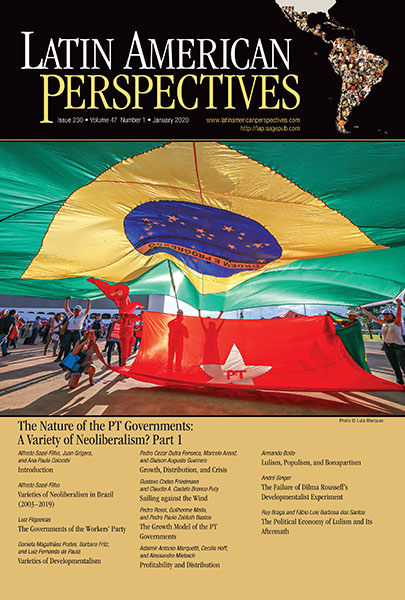
The Nature of the PT Governments: A Variety of Neoliberalism? Part 1

Jan. 2020 Issue Editors: Alfredo Saad-Filho, Juan Grigera and Ana Paula Colombi The articles in this two-part special issue discuss the nature, strengths, achieve-ments, contradictions, and limitations of the administrations led by the PT in federal government, questioning whether they can be characterized as a variety of neoliberalism. The almost 20 articles cover a variety of topics such as macroeconomic policies, political alliances, foreign policy, labor reforms, regional development and social policy. The special issue was edited under the principle that understanding the PT governments and their achievements and limitations is essential not only for academic reasons or for coming to terms with history but to contribute to a reorganization from the paralysis of the progressive camp in Brazil.   TABLE OF CONTENTS | PURCHASE THIS ISSUE

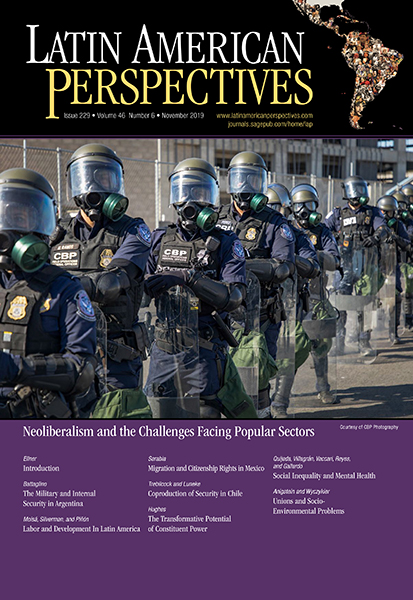
Neoliberalism and the Challenges Facing Popular Sectors

Nov. 2019 Issue editor: Steve Ellner The articles in this issue explore specific negative aspects of the policies and strategies followed by the champions of globalization and neoliberalism as well as proposals and actions associated with their critics. Topics include the proposal to assign matters of internal security to the armed forces in Argentina; the labor policy of four pro-and anti-neoliberal governments; how racial and class discriminatory policies of U.S. immigration officials have mold the attitudes of their Mexican counterparts; the potential of constituent assemblies for far-reaching change; the relationship between mental health and income inequality; and the anti-neoliberalism of the hemispheric labor movement.   TABLE OF CONTENTS | PURCHASE THIS ISSUE

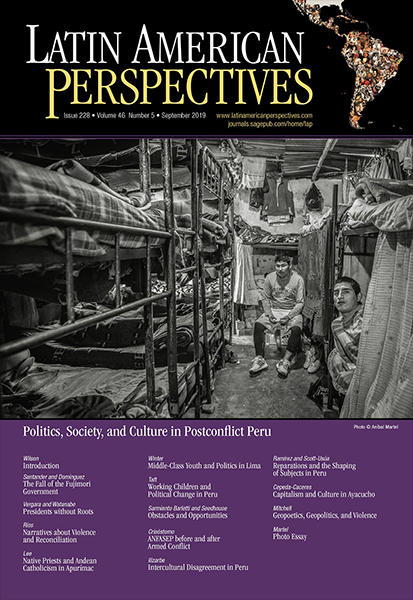
Politics, Society, and Culture in Postconflict Peru

Sept 2019 Issue editor: Kristi M. Wilson This issue of Latin American Perspectives focuses on the post-conflict period from Alberto Fujimori’s resignation in 2000 to the present, thus, challenging some of the popular notions of Peru as an exemplar of post-conflict reconstruction. The essays herein addresses important contributing factors to the Peruvian post-conflict landscape such as: questions of democracy and authoritarianism; extractivism, neo-extractivism and inequality among Peruvian indigenous communities; post-conflict development programs and initiatives; post-conflict reparations programs, the legacy of family planning programs in Peru; and the relationship between indigenous communities and the Peruvian state.   TABLE OF CONTENTS | PURCHASE THIS ISSUE

Environmental Violence in Mexico

Title: Environmental Violence in Mexico Issue #: 204  | Volume #: 42 | Number #: 5 Date: September 2015 Interviewer: Tomas Ocampo Interviewees: Nemer E. Narchi Short Description: This issue analyzes the outcomes of the neoliberal restructuring of Mexico in socio-environmental terms. In doing so, the featured articles rely on the critical lenses of political ecology and political economy to show how individual capitals and policy makers use the political, economic and constabulary forces to create asymmetries that will allow for capital accumulation while creating social injustice and environmental degradation. The issue also features the application of natural selection to the issue of sustainability; highlights the consequences of transforming nature into property; criticizes the legitimacy of human rights policies; questions the violence of representing nature; and deals with environmental violence not only as structural but as a direct and brutal kind of violence used for legitimizing neoliberal restructuring while imposing one particular definition of nature and natural resources. LATIN AMERICAN PERSPECTIVES is a theoretical and scholarly journal for discussion and debate on the political economy of capitalism, imperialism, and socialism in the Americas. For more than forty years, it has published timely, progressive analyses of the social forces shaping contemporary [...]

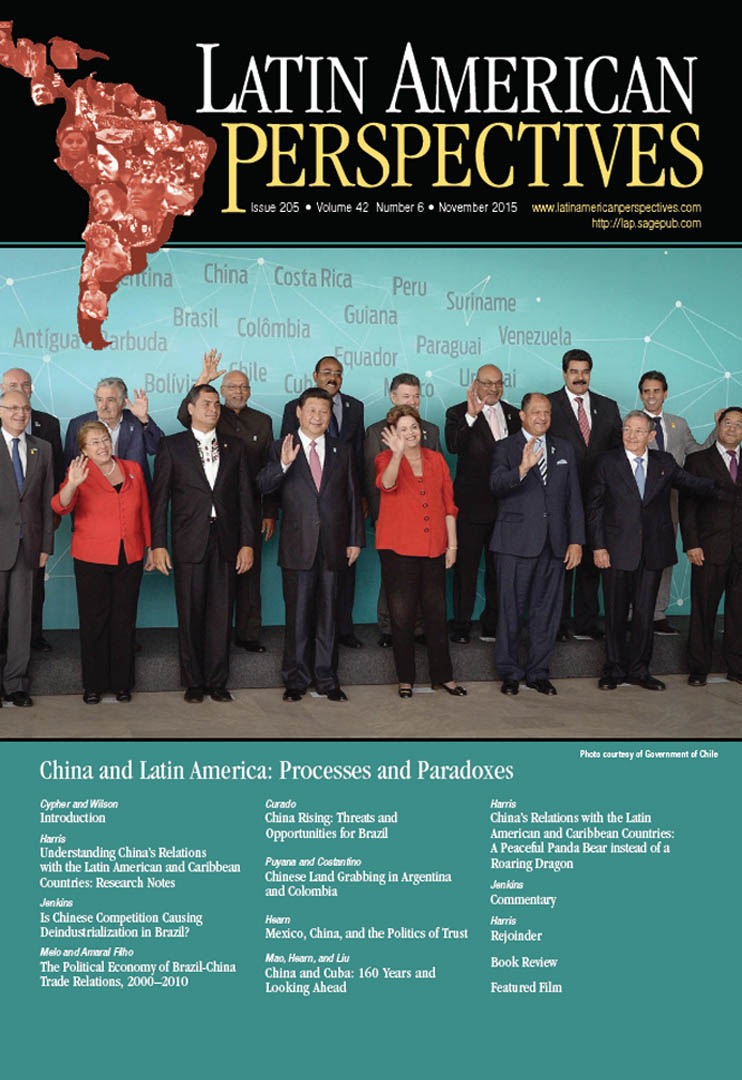
China and Latin America: Processes and Paradoxes

Title: China and Latin America: Processes and Paradoxes Issue #: 205  | Volume #: 42  | Number #: 6 Date: November 2015 Interviewer: Tamar Diana Wilson Interviewees: Tomas Ocampo Short Description: How has the increasing economic influence of China, especially since 2000, affected Latin American countries? Has China’s recent impact led to a structural shift in the underlying political economy of the region? Has this effect been, on balance, positive, negative, or too complex to be reducible to a normative analysis? Is it the case that, because of ongoing dynamics and the generation of ever newer accords, reached annually if not biannually between China and various Latin American countries, such an assessment lies only in the future? LATIN AMERICAN PERSPECTIVES is a theoretical and scholarly journal for discussion and debate on the political economy of capitalism, imperialism, and socialism in the Americas. For more than forty years, it has published timely, progressive analyses of the social forces shaping contemporary Latin America. http://latinamericanperspectives.com

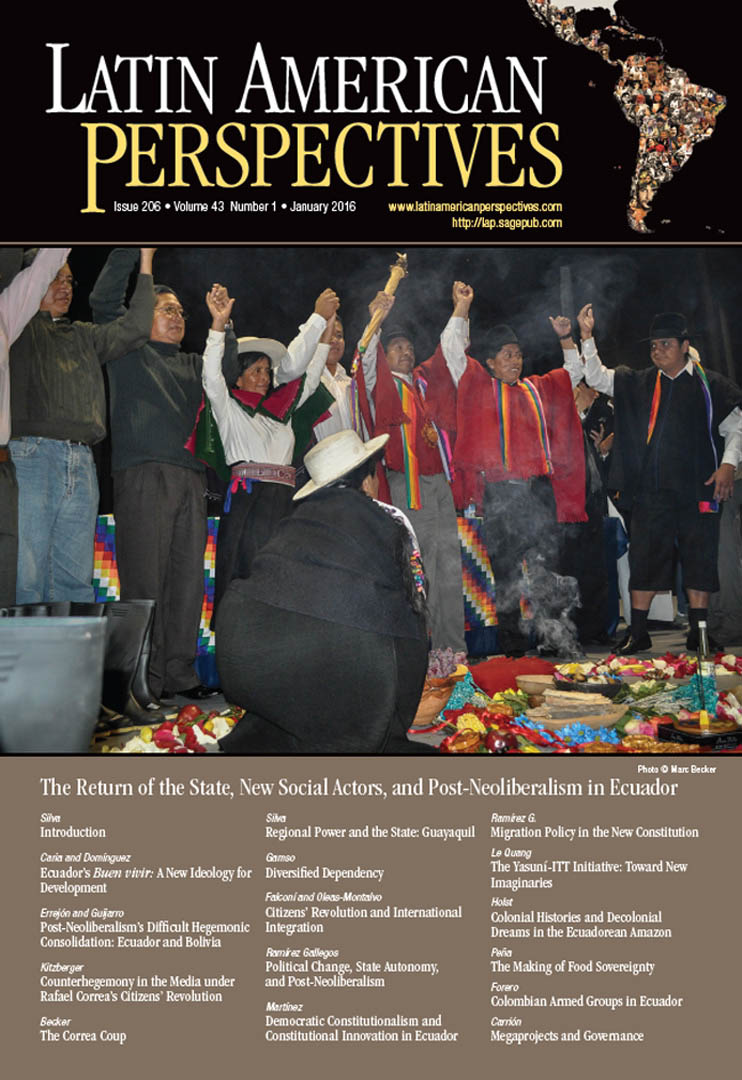
The Return of the State, New Social Actors, and Post-Neoliberalism in Ecuador

Title: The Return of the State, New Social Actors, and Post-Neoliberalism in Ecuador Issue #: 206  | Volume #: 43 | Number #: 1 Date: January 2016 Interviewer: Tomas Ocampo Interviewees: Veronica Silva Short Description: This issue brings together critical contributions to help appreciate some dimensions of the profound impact of the deep socio-economic and political transformations that the Citizen Revolution led by Rafael Correa has been pushing for since its inception in 2007. The main purpose of the issue is to arrive at a global picture of the evolution and the vicissitudes of the processes of political change in contemporary Ecuador, assess its limits and contradictions from the standpoint of various analytical approaches. It covers such diverse topics as the struggle for power, the reform of state institutions towards a more centralized model, economic and trade policy, change in Ecuador’s approach to international relations, the question of constitutional change, tensions between the government and social movements, socio-environmental conflicts, the new migration agenda, and the question of the post-neoliberalism. LATIN AMERICAN PERSPECTIVES is a theoretical and scholarly journal for discussion and debate on the political economy of capitalism, imperialism, and socialism in the Americas. For more than forty years, it has published [...]